Read to learn how my proprietary audit uncovered why 150,000 keywords disappeared for a large industrial distributor, and the strategy I recommended to recover lost search visibility.
This is an anonymized, but real, audit built the same way I'd run one for a new client. It shows the methodology and tooling behind how I diagnose off-site search performance, score AI readiness with my proprietary crawler, and evaluate on-site search & UX.
The subject: an industrial distributor (anonymized as "Client," benchmarked against "Comp 1" and "Comp 2"), turned around in one week.


A sample of high-volume terms where Client ranks poorly while both competitors are consistently ranked near the top (smaller number is better).
Two funnel stages, benchmarked against two competitors: off-site organic and AI search, then on-site search and UX.
Traced the traffic gap against Comp 1 and Comp 2 using SEMRUSH, isolating the August 2024 update as the point of collapse.
Benchmarked rank on high-volume generic terms to show which products are effectively invisible to search engines.
Ran product pages through a custom Python crawler that scores structured data against AI and agent-commerce signals.
Tested cross-reference and compare functionality on desktop to confirm what already works well.
Walked mobile search and filtering end to end, flagging persistence, ordering, and layout issues.
Compared facet order against both competitors to identify where function should come before form.
Competitive intelligence, a proprietary readiness scorer, and hands-on UX testing across desktop and mobile.
Traffic trends, keyword rankings, and competitor benchmarking.
Recommended deep-dive to isolate indexing and crawl issues.
Python crawler that scores product pages and flags fixes for structured data and schema.
Hands-on desktop and mobile search testing using real product test cases.
Structured comparison of filter order and behavior against competitors.
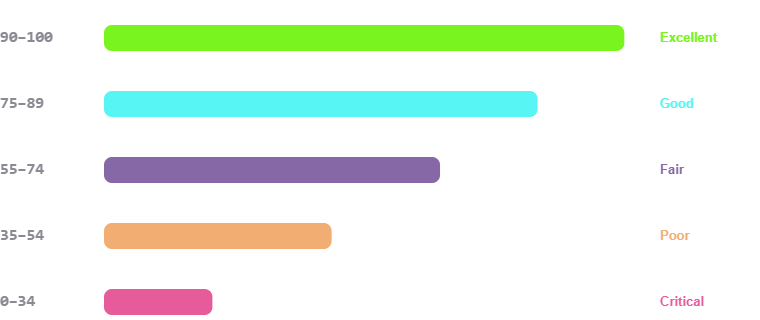
Structured data is what lets AI assistants accurately identify, cite, compare, and recommend products in conversational search. I built a Python tool that crawls product pages directly, then scores each one against the schema and content signals AI and agent commerce actually rely on.
The output isn't just a score, it's a prioritized list of what's missing or broken, and how to fix it. In this sample, one product page was scored; a complete audit crawls the full catalog.
Recapture demand across 150K+ products, fix the on-site experience on mobile and then desktop, and close the gap with competitors while building a scalable foundation for AI-driven search.


